

The book of Job reveals everyone’s opinions about the reason for suffering and how God runs the world. Job has challenged that God has not treated him fairly. He does not think that God has not been right toward him because Job has been blameless and upright. Job’s friends have an opinion that Job must have sinned for all of this calamity to fall on him. Elihu has offered his speeches in which he disagrees with Job and with the three friends (cf. Job 32:1-5). Elihu defends God and challenges what Job has said about God. Elihu does not say that Job sinned and that is why he is suffering. Elihu says that Job’s words have been wrong about God. But there is one person we have not heard from in all of these discourses. We have not heard from God. We have not heard God speak since the first two chapters of the book when God and Satan were talking about the righteousness of Job. As Job and the three friends argued about how God runs the world, we did not know that Elihu was there, listening and then responding on God’s behalf. But even as all this was going on, they did not know that God was there, listening and about to respond on his own behalf. In Job 38 God himself will take the opportunity to speak. What I want us to think about for these final four chapters of the book is God’s message. What do you think God is going to say about suffering? What do you think God is going to say about how he runs the world? How do you think God is going to defend himself? How will God explain himself regarding what he has allowed Satan to do in this trial?
God’s Challenge (Job 38:1-3)
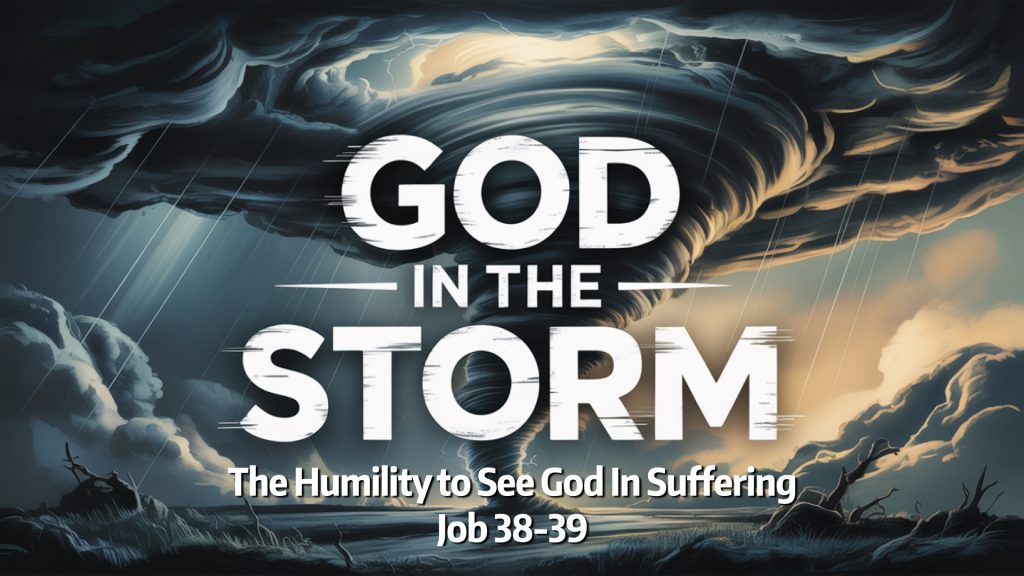
Before we can listen to God’s words, I want the picture of Job 38:1 to settle on our minds for a moment. The Lord answered Job out of the whirlwind. We need to visualize a powerful whirlwind storm. I picture this as a powerful tornado coming into view. Maybe this was more like a hurricane or a lightning storm when the winds start blowing the branches and leaves everywhere. Whatever works in your mind, I want you to visualize that God introduces himself by speaking from a powerful storm.
Please consider the first words that God proclaims. Who is this who darkens my counsel with ignorant words? Who is this who obscures my plans and purposes without knowledge? Please notice that God challenges what Job has said. What God says is exactly what Elihu said. Elihu said, “Job speaks without knowledge; his words are without insight” (Job 34:35). Elihu said, “Job opens his mouth in empty talk; he multiplies words without knowledge” (Job 35:16). God makes the same challenge of Job. Who do you think you are to say the things that you have said about me?
I want you to notice the strategy of God’s discussion with Job. Look at Job 38:3. Get ready! Brace yourself! Dress for action like a man to go to battle! “I will question you, and you will inform me.” Job has been questioning God. But notice that God does not say that he is going to answer all of Job’s questions. Rather, Job has been questioning God. Now God is going to question Job and demand that Job answer him. God in the storm has questions that now you must answer. The tables have been turned. It sure is easy to ask a lot of questions that challenge God and darken his counsel. But if you want to challenge God then you need to answer some questions.
God’s Questions (Job 38:4-40:2)
What we now read for the next two chapters is God offering a flurry of questions to Job to answer. As you read chapters 38-39 you will see that the questions center on three types of questions: “Who are you?” “Where were you?” “Have you…?” For example, in Job 38:4 God wants to know where Job was when God established the earth and marked off its dimensions. Who told the waters to go so far but no further (Job 38:8-11)? Job 38:4-38 is God running through the various aspects of the creation and asking Job if he did these things or can do these things. Can you bring out the stars or send out lightning bolts (Job 38:31-35)? Can you tell the clouds to send a flood? Then, after God questions Job about the creation and how things work in the world, God questions Job about the animals of the creation in Job 38:39-39:30. God wants to know if Job can provide for all the animals like the lions and ravens. God wants to know if Job was the one who made the animals do the inexplicable things that they do. I love the description God gives of the ostrich in Job 39:13-18. Basically, God is asking Job to explain how the ostrich even survives. God did not give the ostrich wisdom or good sense but they thrive. Or maybe Job can explain the strength of the horse and how humans use them in battle and they do not fear (Job 39:19-25). Job has wanted God to explain himself and make what he has done make sense. God’s answer is to question Job, make Job explain himself and everything in creation.
Jump to Job 40:1-2 because this is the point of God’s questioning of Job. Do you want to still argue with the Almighty God? Do you want to try to correct God? Do you want to keep questioning God? Since you think you have the wisdom to question God, then answer God’s questions that he has for you. We think we have questions that God must answer. But we have this wrong. Instead, God has questions that we must answer! Now it is important to be clear here. We can have questions. Habakkuk had questions. Jeremiah had questions. The disciples of Jesus had questions. John the Baptizer had questions. The problem is not that we have questions. The problem is when our questions challenge the wisdom of God and the way he runs the world and our lives. If Job wants to question God in this way, then be prepared to have some answers for how the creation came into existence and operates.
Job’s Response (Job 40:3-5)
Now it is Job’s turn to answer the Lord. You will notice that Job does not have answers. Job will not and cannot rebut the Lord. There are two things that Job immediately realizes about what he has said. First, Job covers his mouth. Job realizes he should not have said the things that he said when it came to challenging God, his wisdom, and how he runs the world. He should not have challenged God’s justice and how God is operating in his life. So in verse 5 Job proclaims that he said too much and I will not say anything more. Job realizes that he has said far too much. I think this is an important point for us to grasp.
We say far too many challenging things against God and what he is doing in our lives. We recently went through the book of Lamentations and we noted that we are able to express our pain and confusion to God. But then we need to leave it there. Then we need to rest in the wisdom and goodness of God. I want us to think about God’s final words to Habakkuk. Remember that the prophet Habakkuk does not understand what God is doing in the world and with his people. There is violence and injustice and it does not seem like God is doing anything. God answers by telling Habakkuk that he is going to do something that he would not believe even if it were told to him. God’s answer of using the Babylonians to judge Judah did not make sense to Habakkuk at all. So Habakkuk has more questions for what God is doing. The key answer that God gives back to Habakkuk is in Habakkuk 2:4, “The righteous one will live by faith.” You have to trust me, Habakkuk. This statement is so important that it is quoted three times in the New Testament. The walk of the Christian is to walk by faith. We have to trust God. But again, please think about how God ends his discussion with Habakkuk.
“But the LORD is in his holy temple; let all the earth keep silence before him.” (Habakkuk 2:20 ESV)
What did God say? There is a time to stop talk and understand that God is ruling. The third chapter of Habakkuk is not more questions from Habakkuk to God. The final chapter is Habakkuk praising God in spite of the suffering and judgment that is about to come. There is a time to stop talking and let God be God. We have asked our questions. But now we must move to faith. The Lord IS in his holy temple and it is time to put our hands over our mouths and have nothing more to say. If we believe that the Lord knows what he is doing, then the questions stop, the lamentations end, and we rest in the wisdom of God.
But there is one more important response that we see in Job from God’s first speech. Look again at Job 40:4. Job begins by saying, “I am of small account.” Some translations say that Job is unworthy or insignificant. I am nothing. I am contemptible. What is Job saying? Job is saying that he should have expressed some humility in his suffering. This is where the visual of God in the storm is helpful. God speaking from the storm reminds Job that he is of small account. One of the things that the scriptures are very clear about is that God runs the world in a way so that people will not boast in themselves but boast in the Lord. The apostle Paul makes this point about our salvation in 1 Corinthians 1:28-31. When Jeremiah and the people do not understand the suffering that is about to come upon them, this is one of the answers that the Lord gives.
Thus says the LORD: “Let not the wise man boast in his wisdom, let not the mighty man boast in his might, let not the rich man boast in his riches, but let him who boasts boast in this, that he understands and knows me, that I am the LORD who practices steadfast love, justice, and righteousness in the earth. For in these things I delight, declares the LORD.” (Jeremiah 9:23-24 ESV)
Our only glory is in knowing the Lord. Our suffering exposes our pride. Our trials show our self-reliance. Our pain can show what we put our hope and glory in. One of the goals of our trials is to expose our pride and to humble ourselves before God. This is exactly what the apostle Paul learned.
So to keep me from becoming conceited because of the surpassing greatness of the revelations, a thorn was given me in the flesh, a messenger of Satan to harass me, to keep me from becoming conceited. Three times I pleaded with the Lord about this, that it should leave me. But he said to me, “My grace is sufficient for you, for my power is made perfect in weakness.” Therefore I will boast all the more gladly of my weaknesses, so that the power of Christ may rest upon me. For the sake of Christ, then, I am content with weaknesses, insults, hardships, persecutions, and calamities. For when I am weak, then I am strong. (2 Corinthians 12:7-10 ESV)
We need humility when suffering. We need to learn humility through suffering. We are told in Hebrews 5:8 that even though he was the Son, Jesus learned obedience through what he suffered. We must learn humility. We must learn obedience. We must learn submission. We must learn reliance. We must learn faith. We are small and insignificant before the Almighty God.
So I want to end our lesson today with an important question. What would God contend with you about? God is contending with Job because of what he has said during his trial. What would God contend with you about for what you said or did in your trial? What questions would God be asking you because of the questions you have asked of him? We do not want to have an oops day on the day of judgment. We do not want to stand before God and say that I should have put my hand over my mouth. I said too much. I acted without faith. Humble yourself under God’s mighty hand. Remember who you are and who God is because he is speaking to you in the storm.